
Best Performance Management Tools for Performance Reviews in 2026
Your current performance review process likely eats up hours in manual form-building and spreadsheet wrangling. Many teams switch tools when feedback gets lost in inboxes or goals drift from daily work. The right platform turns reviews into a continuous loop of coaching and clarity.
This guide covers what to look for in review software, from customization to OKR alignment. You'll get detailed breakdowns of six leading tools, including HeyRamp's all-in-one approach with personality insights, plus a clear verdict on which platform fits different team sizes and budgets.
What to Look For in Performance Management Tools
Selecting the right performance management tool hinges on understanding the core capabilities that drive employee development and organizational alignment. The best platforms do far more than digitize an annual review form. They streamline the entire review cycle while supporting continuous feedback and connecting everyday work to larger company goals.
As you evaluate performance management software, focus on solutions that reduce administrative burden rather than add to it. Review cycle automation and customizable workflows save managers hours each quarter. Meanwhile, real-time feedback tools keep conversations flowing between formal checkpoints.
Integration matters just as much as standalone features. A strong platform should connect with your existing HRIS and goal setting software. This creates a single source of truth for performance data, making it easier to spot trends and act on them.
Keep these priorities in mind as you compare options. The right employee evaluation platform should feel intuitive for managers and employees alike. If a tool requires heavy training or constant manual updates, it will likely fail to gain traction across your organization.
Core Review Features and Customization
A robust performance management tool must offer customizable review templates that adapt to your organization's unique competency framework and rating scales. No two companies evaluate talent the same way. Your platform should let you build performance appraisal templates that reflect your specific values, skills, and job roles.
Look for flexible rating scales that match your philosophy. Some organizations prefer simple 1 to 5 scales, while others use behavioral anchors or narrative-based evaluations. The ability to configure these options ensures the tool works for your culture, not against it.
Automated review cycles are another essential feature. The software should handle scheduling, reminders, and document routing automatically. This eliminates the administrative scramble that typically accompanies review season.
Calibration sessions deserve attention during your evaluation. These meetings help managers align their ratings and reduce bias across teams. The best tools support calibration by presenting side-by-side comparisons of employee scores and providing discussion prompts.
Modern platforms also support multiple review types within a single system. Consider whether you need:
- Self-assessments for employee reflection
- Peer review tools for collaborative input
- Manager evaluations for formal scoring
- 360-degree feedback for a complete picture
Competency assessment and skills gap analysis turn reviews into actionable development plans. When a tool highlights where skills fall short, HR can respond with targeted training or succession planning initiatives. This transforms the review from a backward-looking report into a forward-looking growth tool.
Goal Alignment and OKR Integration
Goal alignment is the backbone of performance management, ensuring every employee's work contributes to the company's strategic objectives. Without this connection, reviews become disconnected from what actually matters to the business. Strong goal setting software bridges that gap.
When evaluating OKR tracking capabilities, look for transparent visibility into progress. Managers should see at a glance how team efforts support broader company objectives. Employees should understand how their daily tasks roll up to larger outcomes.
Cascading goals are a critical feature to examine. This functionality lets company objectives flow down to department, team, and individual levels. When priorities shift, the system should propagate those changes automatically so everyone stays aligned.
Automatic progress updates save time and keep data current. Rather than asking employees to manually update statuses, the best tools pull in metrics from connected systems. This real-time performance monitoring gives leaders an accurate picture without extra effort.
Periodic check-ins matter as much as the annual review. Look for tools that encourage regular goal reviews and allow adjustments as business needs evolve. Static goals set in January may be irrelevant by June. Flexibility in goal management keeps performance conversations grounded in current reality.
Consider how the tool handles goal visibility across the organization. Some platforms offer public goal boards that foster transparency and collaboration. Others restrict visibility to managers only. Think about which approach fits your culture before making a decision.
Feedback and 1-on-1 Meeting Capabilities
Continuous feedback and structured 1-on-1 meetings are vital for fostering a culture of ongoing development and engagement. The annual review alone cannot capture the full picture of an employee's contributions. Real-time feedback systems fill the gaps between formal evaluations.
Look for tools that make giving feedback quick and natural. The best continuous feedback systems integrate into daily workflows, so recognition happens in the moment rather than weeks later. Peer recognition features build morale and reinforce desired behaviors across teams.
Manager check-in tools structure one-on-one conversations productively. Built-in meeting agendas keep discussions focused on priorities, challenges, and growth opportunities. Action item tracking ensures follow-through on commitments made during these sessions.
Feedback history is another crucial element. A searchable record of past conversations gives managers context before each check-in. Employees can also review their own feedback to track progress and identify patterns over time.
Some platforms include built-in employee engagement surveys to gauge sentiment between reviews. These pulse checks reveal emerging issues before they escalate. Integration with communication platforms makes these tools easier to adopt since feedback lives where employees already work.
Evaluate how organized the feedback remains in each system. Scattered emails and sticky notes create blind spots. A centralized feedback repository ensures nothing gets lost and every conversation builds on the last.
1. HeyRamp - Best Overall
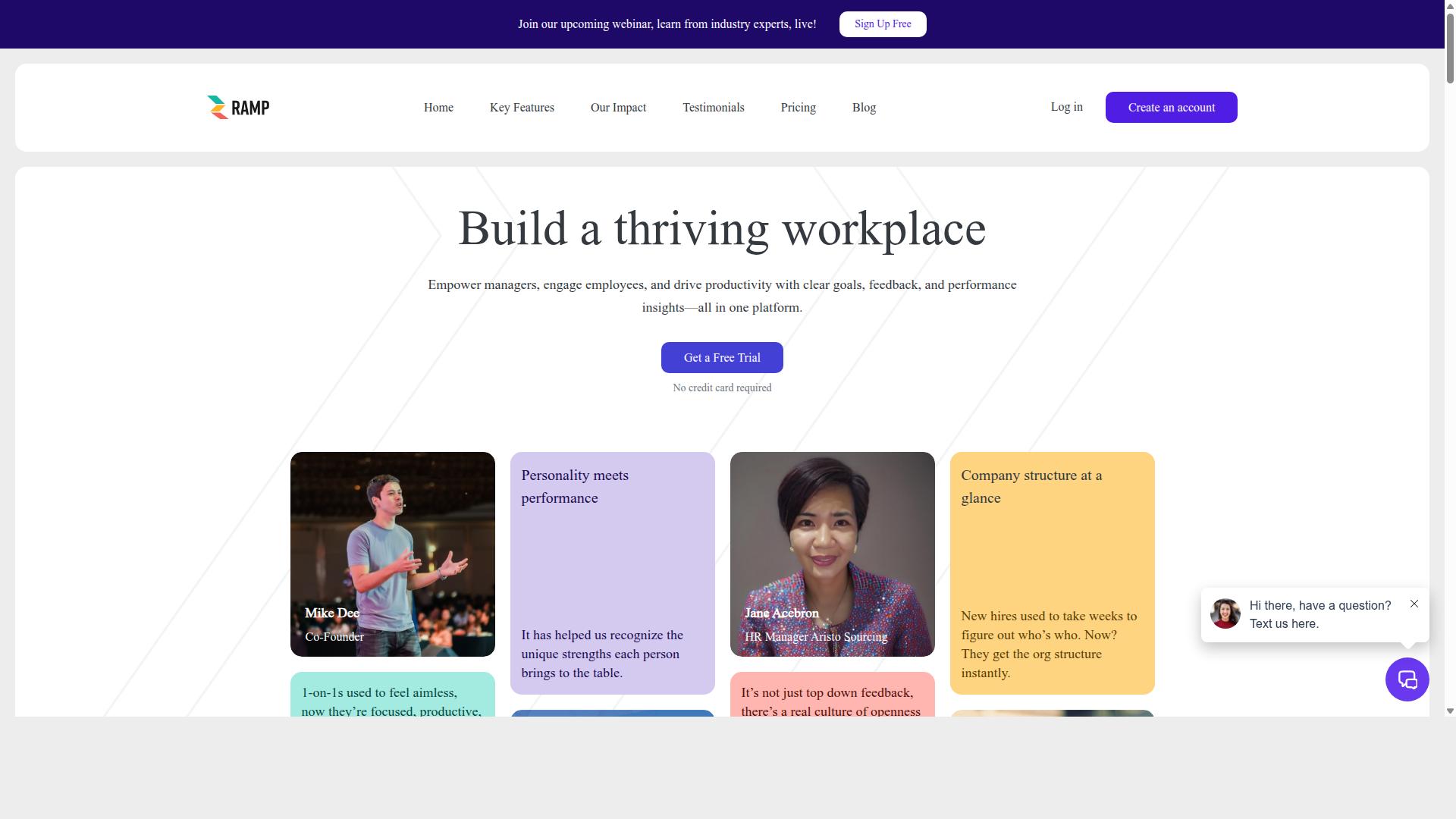
HeyRamp stands out as the best overall performance management solution, combining an all-in-one platform with unique features like personality insights and built-in coaching. It is trusted by over 20 organizations and 400+ teams, making it a proven choice for modern workplaces.
The platform integrates feedback, reviews, and team development into a single system. This unified approach eliminates the need to juggle multiple tools for different aspects of performance management.
For 2026 HR technology buyers, HeyRamp delivers a complete package. It covers everything from continuous feedback systems to structured performance appraisals, all within one accessible interface.
This makes it a versatile option for organizations that want a single source of truth. Instead of stitching together separate employee evaluation platforms, teams get one cohesive solution that supports the entire review cycle.
All-in-One Platform with Personality Insights and Coaching
HeyRamp's all-in-one platform goes beyond traditional reviews by offering personality insights and built-in coaching to enhance team dynamics and individual growth. The company structure visualization gives managers a clear view of reporting lines and team composition.
The 1-on-1 meeting tools come with organized agendas and action tracking. These manager check-in tools help keep conversations productive and ensure follow-through on discussed items.
Personality insights are integrated directly with performance tools. This connection helps managers understand communication styles and work preferences, which supports more effective coaching conversations.
Built-in training videos cover 1-on-1s, performance reviews, and personality testing. These education resources support continuous development without requiring external training programs.
The platform also supports 360-degree feedback and employee engagement surveys. These features give a fuller picture of performance beyond just manager assessments.
Additional capabilities include OKR and goal management with real-time progress visualization, guided conversation templates, coaching tips, and sentiment prompts. Automated reminders keep the review cycle on schedule.
For compliance needs, HeyRamp offers documentation with time-stamped secure records. People analytics dashboards and leadership insights help leadership teams spot trends across the organization.
Transparent Pricing and Global Accessibility
With transparent pricing starting at just $5 per seat monthly and global availability, HeyRamp offers exceptional value for organizations of all sizes. The pricing structure is straightforward and predictable.
- $5.00 per seat per month when paid monthly
- $3.00 per seat per month when paid annually
- Custom enterprise pricing paid per seat
A 14-day free trial requires no credit card. Users get full access from day one, which makes evaluating the platform risk-free.
The one flat fee includes all features. There are no tiered plans that hide essential tools behind higher price points, which simplifies budgeting for finance teams.
HeyRamp is available worldwide online. This global accessibility makes it suitable for distributed teams and organizations with employees across different regions.
For companies comparing performance review tools, this pricing model removes the guesswork. Organizations can scale their usage without worrying about unexpected cost increases as their team grows.
2. Lattice
Lattice is a well-known performance management platform that focuses on aligning employee goals with company objectives through continuous feedback and robust review cycles. It is frequently listed among top OKR platforms, with a G2 rating of 4.7 out of 5, which reflects strong user satisfaction across its core modules.
The platform combines performance reviews with OKR tracking, making it a practical choice for organizations that want to connect daily work to broader strategic priorities. Its starting price is reported at $11 per user per month with annual billing, though no free plan is mentioned in public sources.
Key features typically include customizable review cycles, real-time feedback tools, and goal setting software that supports both individual and team objectives. Lattice also offers employee engagement surveys, which can help HR teams measure sentiment alongside formal performance appraisal templates.
Lattice is best suited for mid-sized to enterprise organizations looking for a comprehensive talent management suite. Teams that already have mature HR processes and need a structured way to run calibration sessions, 360-degree feedback, and development plans will find its feature set valuable.
That said, the platform may feel heavier for smaller teams or those seeking a lightweight continuous feedback system. Buyers should evaluate their review cycle automation needs carefully before committing, especially if they want a simpler tool that prioritizes speed over administrative depth.
3. Leapsome
Leapsome differentiates itself with a strong focus on OKR tracking and learning management, making it a good fit for companies prioritizing alignment and development. The platform combines performance review tools with goal setting software, so teams can tie individual contributions directly to company objectives. This integration appeals to organizations that want a single home for strategy execution and people development.
Its review cycle automation supports common formats like 360-degree feedback, manager check-in tools, and performance appraisal templates. Teams can run calibration sessions to reduce bias and keep rating scales consistent across departments. The emphasis on continuous feedback systems also helps managers capture input between formal reviews, which supports a more agile evaluation rhythm.
What makes Leapsome stand out in the 2026 HR technology space is its learning management component. Beyond evaluating past performance, the platform can connect skills gap analysis with development plans and relevant training content. This positions it as more of a talent management suite than a pure employee evaluation platform, which suits companies that view reviews as a starting point for growth rather than an endpoint.
For organizations weighing performance management software options, Leapsome is worth serious consideration when learning and OKR tracking are top priorities. It may not be the simplest tool for teams that only need basic reviews, but it offers a coherent structure for companies that want alignment, accountability, and upskilling in one place. The trade-off is complexity, so teams should evaluate whether they will use the full feature set before committing.
4. PerformYard
PerformYard is a streamlined performance review tool that prioritizes simplicity and customization, making it easy for HR teams to manage complex review cycles. The platform is designed for organizations that want to replace spreadsheets and email chains with a structured, repeatable process.
Its core strength lies in review cycle automation. HR administrators can set up recurring reviews, define timelines, and automate reminders so nothing slips through the cracks. The system handles the administrative heavy lifting, which frees managers to focus on the actual conversation with their employees.
Flexibility is another major selling point. PerformYard offers customizable templates that can be tailored to different departments, roles, or seniority levels. Whether you need a simple annual appraisal or a more complex multi-rater process, the tool allows you to configure forms without requiring technical expertise or developer support.
The platform also integrates with common HRIS and payroll systems, which reduces duplicate data entry. Employee information syncs automatically, ensuring that review records stay accurate and up to date across your entire technology stack.
For companies that want to move away from manual processes, PerformYard keeps things intuitive. The user interface is clean and straightforward, so employees and managers can complete their tasks without extensive training. It is a practical choice for HR teams that value efficiency over feature bloat.
While it may not offer the deepest analytics or advanced succession planning capabilities found in larger talent management suites, PerformYard covers the essentials well. It is best suited for organizations that need a dependable, easy-to-adopt system for performance appraisal templates and continuous feedback systems without overwhelming their workforce.
5. Peoplebeam
Peoplebeam offers a modern approach to performance management with a strong emphasis on continuous feedback and employee development. The platform positions itself as an emerging option for teams that want to move beyond the traditional annual review cycle.
Its feature set typically includes 360-degree feedback, goal tracking, and succession planning capabilities. These tools aim to help managers identify rising talent and prepare employees for future roles within the organization.
For organizations that value a people-centric approach, Peoplebeam may be worth evaluating. The platform appears designed to support ongoing conversations rather than relying solely on periodic evaluations.
Succession planning is a notable differentiator in this space. Many performance review tools focus on past performance, while Peoplebeam seems oriented toward future potential and internal mobility.
That said, because Peoplebeam is still establishing its footprint in the 2026 HR technology market, interested teams should verify current availability and implementation requirements directly. As with any emerging vendor, it is wise to request a demo and test the workflow against your specific review cycle needs before committing.
6. Primalogik
Primalogik is a budget-friendly performance management solution that covers the essentials without compromising on functionality. It is designed with small to mid-sized businesses in mind, offering a practical way to run performance reviews without a steep learning curve. For teams that want structure without complexity, this platform often serves as a straightforward entry point into modern review processes.
The platform typically includes customizable performance reviews, allowing organizations to shape appraisal templates around their specific roles and competencies. Alongside this, Primalogik provides 360-degree feedback tools that gather input from peers, managers, and direct reports. This makes it easier to get a fuller picture of an employee's contributions beyond just the manager's perspective.
Employee engagement surveys are another core component, helping leaders gauge sentiment and identify potential issues before they grow. These surveys can be scheduled regularly, giving HR teams a steady stream of feedback to act on. When paired with review data, this information can support better decisions around retention and team health.
Simplicity is a defining characteristic of this tool. The interface leans toward clean and intuitive, which means managers are more likely to complete their reviews on time. That ease of use can be a major factor for cost-conscious organizations that lack dedicated HR technology teams to manage complex systems.
For businesses looking for an employee evaluation platform that prioritizes core review cycle automation over advanced analytics, Primalogik is worth consideration. It delivers solid value for organizations that want to move away from paper-based appraisals. The trade-off is that it may not offer the depth of workforce analytics or succession planning found in larger talent management suites, which is a reasonable compromise for its price point.
How to Choose the Right Option
Choosing the right performance management tool requires a clear understanding of your organization's size, structure, and budget constraints. The market in 2026 offers everything from lightweight feedback apps to full talent management suites, and the differences matter more than ever.
Start by mapping your requirements against your current HR strategy. A tool that works for a 20-person startup will likely frustrate a 2,000-person enterprise, and vice versa. Your choice should reflect how your company actually operates, not just what looks impressive on a demo call.
Consider the full lifecycle of performance reviews, not just the annual event. Do you need continuous feedback systems, OKR tracking, 360-degree feedback, or succession planning? Each of these capabilities adds complexity and cost, so prioritize what your teams will genuinely use.
Integration is another critical factor. Your performance review tools should connect with your existing HRIS and payroll systems to avoid duplicate data entry and reporting gaps. Review cycle automation and workforce analytics only deliver value when they draw from accurate, current information.
Matching Tool Size to Team Structure and Budget
The ideal performance management tool should scale with your team and fit within your budget, whether you're a startup or an enterprise. Small teams often prioritize simplicity and low cost, while larger organizations typically need advanced features like succession planning and robust reporting.
For small and mid-sized teams, look for tools that offer clear performance appraisal templates and manager check-in tools without overwhelming complexity. Per-seat pricing can add up quickly, so calculate your total annual cost before committing. Annual contracts often lock you in, so verify that the pricing model matches your growth trajectory.
Larger enterprises should evaluate tools that support calibration sessions, performance scoring, and rating scales across multiple departments. Skills gap analysis and development plans become essential when you manage hundreds of employees across different functions. Succession planning and workforce analytics are often the deciding factors for mature HR teams.
Integration with existing HRIS and payroll systems is crucial for seamless data flow. A tool that requires manual exports or duplicate entry will erode adoption quickly. Look for platforms that connect naturally with your current technology stack, and always test the integration during your evaluation period.
Take advantage of free trials to test usability before making a decision. Have your managers and HR team members try the software with real scenarios, not just the vendor's demo data. Real-world testing reveals friction points that marketing materials never mention.
When evaluating options like HeyRamp, consider how its capabilities align with your needs. HeyRamp serves leadership, line managers, human resources, and individual contributors, making it a versatile choice for organizations seeking improved performance management, employee engagement, goal alignment, and team development. This breadth of audience coverage means the tool supports everyone from executives to individual contributors, which simplifies adoption across the organization.
Finally, think about your company culture. A tool that encourages frequent, informal check-ins may suit a collaborative environment, while a structured, formal review process might fit a more traditional workplace. The right performance management software should reinforce your values, not fight against them.
Final Verdict
After evaluating the top performance management tools, HeyRamp emerges as the best overall choice for its comprehensive feature set, transparent pricing, and global accessibility. The platform combines the essential elements of modern performance review tools into one cohesive system, eliminating the need to stitch together separate solutions for reviews, training, and people analytics.
What sets HeyRamp apart is its one flat fee pricing model, which removes the guesswork from budgeting for 2026 HR technology. Many employee evaluation platforms charge per user or per feature, making costs difficult to predict as your organization grows. With HeyRamp, the pricing stays consistent regardless of team size, a significant advantage for scaling companies.
The platform is already trusted by 20+ organizations and 400+ teams, a track record that speaks to its reliability across different industries and company sizes. This broad adoption matters when you are selecting performance management software, because it indicates the system handles varied review cycles, competency assessments, and calibration sessions effectively.
Beyond the core review features, HeyRamp includes built-in training and education resources. This means managers and employees learn how to conduct better reviews without leaving the platform, which reduces the learning curve and improves adoption rates across your organization.
One of the most distinctive aspects of HeyRamp is its personality insights integrated with performance tools. Understanding how different team members communicate and work best adds a valuable layer to performance scoring and development plans. Combined with instant coaching tips and automated reminders for managers, the platform supports better conversations throughout the review cycle.
For leadership, HeyRamp provides aggregated people analytics dashboards that surface trends across teams. Managers also benefit from guided conversation templates for difficult discussions, a practical resource that many performance review tools overlook. These features work together to support continuous feedback systems and manager check-in tools without requiring additional software.
When choosing among performance management tools for 2026, consider your organization's specific needs first. Some teams prioritize 360-degree feedback, while others need stronger OKR tracking or succession planning capabilities. Evaluate whether a tool offers the right balance of features, ease of use, and administrative overhead for your HR team.
Transparency in pricing and feature availability should factor heavily into your decision. Many platforms advertise attractive starting prices but charge extra for essential modules like employee engagement surveys or skills gap analysis. A flat-fee model removes that uncertainty and makes budgeting for HR technology more predictable.
HeyRamp also stands out for its automatic compliance documentation, which helps organizations maintain proper records without manual effort. This feature reduces administrative burden while ensuring your review processes meet documentation standards. For companies in regulated industries, this capability alone can justify the investment.
If you are ready to explore what HeyRamp can do for your organization, the 14-day free trial provides ample time to test its features with your actual workflows. Use the trial period to run a sample review cycle, explore the analytics dashboards, and see how the personality insights enhance your existing processes.
Performance reviews work best when the tools supporting them are intuitive, comprehensive, and aligned with how your teams actually collaborate. The right platform should feel like an extension of your management practices, not an additional administrative burden. Explore HeyRamp to see how it fits your organization's unique review process and culture.
Recommended Resources: